Tuesday, August 14, 2012

A thoughtful objective for the London Olympics

As you can imagine, planning for the next Olympics begins as the current one is ending, if not sooner.  We had many meetings and conference calls while still in Beijing in 2008 to talk about London. Marketing , international media relations, participating countries, venues and volunteers are subjects of importance that are discussed endlessly during the strategy sessions.

For London, welcoming the world was job #1. Two key topics came up in our advance discussions. First was venues and how they could be used most effectively.  Second was volunteers or Games Makers as they were officially dubbed.  How would they be selected and then trained.

I think the decision to  include some key Central London venues, away from the Olympic Park, was crucial to the success of the Games. Granted, most of the competitions were at the Park, but using the Horse Guards Parade next to Buckingham Palace, Wembley Stadium for football (soccer), Earl’s Court, Hyde Park for the marathon and, of course, Wimbledon for tennis gave the visitors the opportunity to spread out around town, relieving the pressure on Stratford City where the Park was located. Beach Volleyball at the Horse Guards Parade became the hottest ticket of the Games.

The decision on London venues was an aid to security as well, but more importantly, it made the experience more exciting for the spectators.  Watching the Marathon runners go by Big Ben and down the Mall past Buckingham Palace was truly exhilarating…and it was free.

The various venues used many paid and contract workers (over 300,000) but the difference in the visitor experience, in my opinion, were the 70,000 Games Makers volunteers. Almost a quarter of a million people applied to help wrangle the crowds, the athletes and the media all across the city. Those who received volunteer status were rewarded with a kit that included two polo shirts, two pairs of trousers, two pairs of socks, one jacket, one pair of trainers, a baseball cap, official Games time bag, water bottle, notepad, a brolly “just in case it rains”, a free Oyster travel card to get to the Games from the train station and the thrill of being part of this spectacular event. That was their entire compensation, but, for them, it was more than enough. 

Our good friends at McDonald's were the presenting sponsor for the volunteer efforts and, as usual, they took on that role full force.  The Olympics is their kind of event. there was always a group of athletes queued up for their Big Macs.

Add to that the 8000 London Ambassadors who were guiding tourists around the Capitol and you have quite a contingency.  Always colorful Mayor Johnson commented on the Ambassadors' new uniforms by saying, "I hope you don't feel too ridiculous. We need to overcome our natural British reserve and be a little more like the Australians."  He's never a loss for words.

We met Matthew in the tube station while asking for directions to an office building.  He was from Manchester and was staying with relatives during his stint, sleeping on their couch. It was clear he had strong character and this was very important to him.  He said he would have "paid them to get this job." It was once-in-a-lifetime.

During our stay, we encountered scores of Matthew's all over the city. Interested, enthusiastic and charismatic, they  were having the time of their lives. Their happiness was infectious and it gave the city a feeling of exuberance and exhilaration that has been sorely missed during these stressful times in the past few years.

I listened in on one of the daily volunteer briefing sessions. The trainers were excellent, by the way. They even included some sensitivity training.  Here's just one of the situations the volunteers were confronted with from the workbook that each of them was presented.

Gender/Gender. Identity A spectator approaches you asking politely where the nearest toilets are. You are not sure if the spectator is male or female. What do you do?
a) Panic – you are not qualified to make this decision. Explain politely that you do not know, and sadly cannot be of assistance.

b) Just in case, tell them where the male, female and accessible toilets are.

c) Ask the spectator politely if they are male or female, so that you can direct them appropriately.

Correct Answer: b

That was one of the easier questions.  They wanted everyone to be ready.

Also among the 70,000 were about 5,000 health care professionals who provided services to athletes, spectators and visitors alike. Every expertise imaginable was present and all were used by the millions of attendees at the Games.

This event was incredibly well organized in so many ways.  It was a proud moment for me to be working with the entire organization.

Tomorrow we’re talking Security. I’m almost back on local time.

Monday, August 13, 2012

London takes the Gold

It hardly seems like 4 years since Beijing but it has been and now the London Olympics are officially history.  Beijing was all about the government. The Chinese wanted to mark their place in the world and let everyone know that they were now a major player…and they did that. London, however, had a completely different purpose and they more than lived up to the promise.

 I remember hearing the woman who was then in charge of the London bid saying that they were not trying to compete with Beijing’s breadth, scope and budget. “We have allocated only so much money to this effort and we’re going to use it wisely,” she told the media at the Beijing after party. A lot has changed in the world since 2008 and, although the London budget had to be enlarged a bit, the Brits made an amazing impact  for significantly less than was spent in Beijing.

If Beijing was about the government, London was about the people and what fantastic people they are. From the welcome greeters to the stadium volunteers, the shopkeepers, restaurateurs to the organizers, they had the right attitude and a clear vision of their objective…make every visitor and athlete safe and happy.

The British media says that there were one million out-of-towners in London every day during the Olympics. And estimates were that 200,000 people entered the Olympic Park on a daily basis. I can assure you that the Stratford City tube stop was like opening a flood gate shortly after 7am each day when the doors opened and the waves of visitors came on to the grounds. They even had their own official "starter".

My close English friend told me after the Queen’s Jubilee celebration that “We Brits certainly know how to put on a spectacular event.” Indeed they do and the Olympics was their finest hour in many years. I’ll get into my conversations with the organizers beforehand in another blog but I can assuredly say they were prepared for almost anything and met every challenge that came along.  My daily "Trouble" conference call was primarily a breeze. It was very impressive work both at the Olympic Park and in the city.

The athletes were the stars, as they should be, and they were heralded at every opportunity.  We saw them in restaurants, on the street, in the tube and at the theatre, as well as, watching other competitors with awe. I heard one swimmer say that seeing the athletes in basketball and beach volleyball was an inspiration to her during her own competition.

Much has been said about London’s Mayor Boris Johnson.  Or should I say the Right Honourable the Lord Mayor of London, which is the official title.  He was just re-elected for a second term in May and these Olympics are going to carry him far.  Until I got to London, I thought I might find some similarities between Johnson and Seattle’s slightly off-beat Mayor Mike McGinn.  No such luck.  Mayor Johnson makes McGinn look like a pre-schooler…you should see London’s bike lanes and you can rent a bike from a rack on the street by leaving your credit card.  Whether he’s stuck on zipline cracking jokes with the constituents below or putting on his boogie shoes for the Spice Girls at the Closing Ceremony, Mayor Johnson is every man’s and woman’s mayor.  One British newsman said he looks like he needs a haircut. But the newsman’s partner quickly added, “That IS his haircut.”

Gosh, I’m just getting warmed up and I haven’t even said anything negative about London.  There really isn’t much bad to say…except for the weather.  It sucks as badly as Seattle this summer.  Oh sure, a few glorious days but still lots of cool temperatures and rainstorms throughout the Olympics.  There, see, it’s not perfect.

Seriously, I can unequivocally say that I have never been to a big city, large scale public event where I was more pleased by the experience than the  London Olympics. Tomorrow, I want to talk about the volunteers and the operations of the event…a model for advance planning.

Back into my jet-lagged state for now…

Wednesday, August 1, 2012

Working for the Olympics

Working for the Olympics makes for some special memories. I have spent much of my career working for large scale, public extravaganzas…The Indianapolis 500, the Winter Olympics, the America’s Cup, the Summer Olympics, the World Cup of Soccer (Football), to name a few. I’m doing now what I do for most of my clients and that is using my experience and expertise to help make decisions that will improve, enhance or revitalize the tenor of the event.
Today, this kind of work is done in many ways.  It’s meetings.  It’s emails.  It’s social media.  It’s keeping your finger on the pulse.  It’s talking to people who are part of the experience and some who aren’t or don’t want to be. Being a trusted advisor and strategist is mostly paying attention and making decisions and judgments as quickly as possible.

I say all this because working for the Olympics is not the same as “going to the Olympics”.  It’s not as much as about what’s happening on the field, as it is about what’s going on in the locker room before the match or what happened the night before in town.  I’ll get to see some competition (the live stream is always there now). As usual, we’ll show up at NBC’s Today Show set, unfortunately without my friend Ann Curry. But mostly I’ll be talking with various groups about what’s going on and why certain things are happening or not and what can we do to make the experience a better one.

Before the Games are over in London, I’ll give you my take on what London really thinks of hosting this monumental sports competition.  I’ll also share my feelings about the athletes from around the world who have devoted their lives to getting here.  The difficulties in putting on an event of this size are worthy of comment, as well.  And, finally, what is the global impact of the Olympics in today’s over-communicated society? It will only be my opinion, but that’s all I have.

Jane and I are going to get to see some close friends who live there and, who knows, there may be a Guinness or two in my future.  For sure, it’s an experience to be relished and remembered…after all, the Queen has already jumped out of a helicopter, whatever will be next?


Friday, July 20, 2012

Can you feel it?


We all know about it.  We can watch it on television. It’s waged half way around the world and costs billions of dollars. It’s a drain on the economy. We’re defending our country and those who are representing us are who we care about. It’s not the war in Afghanistan. It’s the Olympic Games.

 Can you feel it? Olympic Fever. We’re coming down with it. 

Every two years now, our country faces the competition.  The rest of the world wants to beat us and we want to rack up as many medals as we can. London will be my 10th Olympiad with some involvement. I’m not counting some minor efforts in three other editions. Over the years,  I’ve worked for sponsors, for athletes, for non-profits, for venues and for organizing committees. Each competition has been in a different locale but the similarities in the activities around the events are pretty amazing.

One thing I’ve learned for certain is that no matter how much advance planning there is, when the opening ceremonies arrive, the operations become free form.  Most of the spectators come from driving distance. Sponsors never use all their benefits and, except for some of the giant multinationals, they are never entirely satisfied.  Locals ALWAYS grumble about the disruption and, during the competition itself, there are always tickets available, usually at a reduced price.  In Beijing, they were giving away thousands of tickets a day just to fill the stands.  The opening ceremonies have the best attendance. Track & Field is always the hot ticket. And the winter games are a crapshoot every time because of the weather and access to the competition, though ice skating draws great crowds, as does hockey…for sure, if you’re in Canada, eh.

For me, it began with 1980 Winter Games in Lake Placid, New York…the year of the “Miracle on Ice” for the US Hockey Team.  I was working with K2 Skis and helped put together their successful bid to be the “Official Ski”.  The original K2 Skis were red, white and blue for a reason.  They were made for the USA Women’s Ski Team.

Customer entertainment is a major factor in any sponsorship and it certainly was in Lake Placid, Calgary and Sarajevo, especially with the Mahre twins, Phil and Steve becoming my clients and winning medals like they were going out of style.  In Atlanta, I worked for Coca-Cola and Helly Hansen (sailing in Savannah). My connections with Coke’s agency McCann Ericson tied me in with them.  The bombing unfortunately put a damper on the enthusiasm at that entire event.  The crisis communications work does trickle down to all the sponsors but especially if you’re in the world headquarters of a company like Coke.

We had just completed organizing and promoting one of our around the world sailing races with a stop in Sydney, when the Olympics showed up there.  Our local corporate contacts, as well as some of the sports organizers there, brought me into the fold to help with international communications and crisis work. Australians certainly have their own way of doing things.  They don’t take advice particularly well but somehow things seem to work out for the best.

Lillehammer and Salt Lake were mostly about long-time client Helly Hansen.  Lillehammer is a cool little  village of about 25,000 people and they did an amazing job of entertaining the world.  Helly is a very Norwegian company with a well-manufactured product. They took great pride in playing a major role in hosting the Olympics.  The organizing committee there was completely engaged and took their job very seriously.  That focus really paid off for them.  In Salt Lake, we also worked with Snowbird Resort, an established client that was one of the host venues.  Friend and owner Dick Bass would not let the Olympics come to town without making a major commitment.  And I did see Mitt Romney, but, no, I didn’t work with him.

The small group of Olympic specialists who travel the world from one Games to next that I have gotten to know over the years, brought me into the Beijing Games.  That event will be very hard to match…ever.  The entire country was behind the effort (or had to be) and no holds were barred.  The commitment was clear and it was a spectacular production. It was a truly enlightening experience to see how the organizers handled it all.

Vancouver was a great host. I saw them through several difficult situations that they managed very carefully and, for the most part, effectively.  The death of a luge competitor in practice before the opening ceremonies and the overzealous celebration after the Canadian win on the ice were both handled with care and compassion.  I was impressed.  And I even got my own cameo on NBC during the Today Show while talking to Jane, who was in Florida visiting her sister and saw me there live on the telly.  Pretty cool.

So now , it’s on to London.  I love the city.  We’ve been travelling there for decades.  It is full of history and the Royals.  We have close friends there and I buy my socks at  Marks & Spencer…wouldn’t feel right without them.  The organizers have the right idea.  They are not trying to compete with previous Games, especially Beijing.  They are going to do things their way, within their budget during these hard times.  It is bound to be fun and exciting on the field.  I mostly want it to be safe.  Jane and I will be there and I’ll let you know how it’s going and what it’s like.  You’ll see the competition on television.  I hope to tell you what’s going on in the concourse, on the river, in the tube and in the neighborhood pub. Cheers for now.

Friday, July 6, 2012

Gone Native...


You’re a native of the place where you were born. Being a local means you’ve lived there for a very long time.  The distinction may be subtle but, to many, it’s important.

The 50th Anniversary of the Seattle World’s Fair has brought the Seattle natives out in full force.  Everywhere I go it seems someone is talking about their early years either right before or right after the Fair. There are natives everywhere but Seattle’s distinct personality makes being born here something a little more special. Yakima, Spokane, Wenatchee, Tacoma, even Bellevue don't count. I'm talking Seattle city limits. Knowing your parents best friends and growing up with their children are badges of honor. Learning to ski in the passes as a child and hiking at Mt. Rainier on the weekends made for the best kind of childhood.  Being a babe in arms when the World’s Fair came along or having your mother carry you to the first round of King Tut in the 70’s or seeing the last movie at the 5th Avenue Theatre are privileged experiences …and being a Patches Pal, well, what more can you say than that.

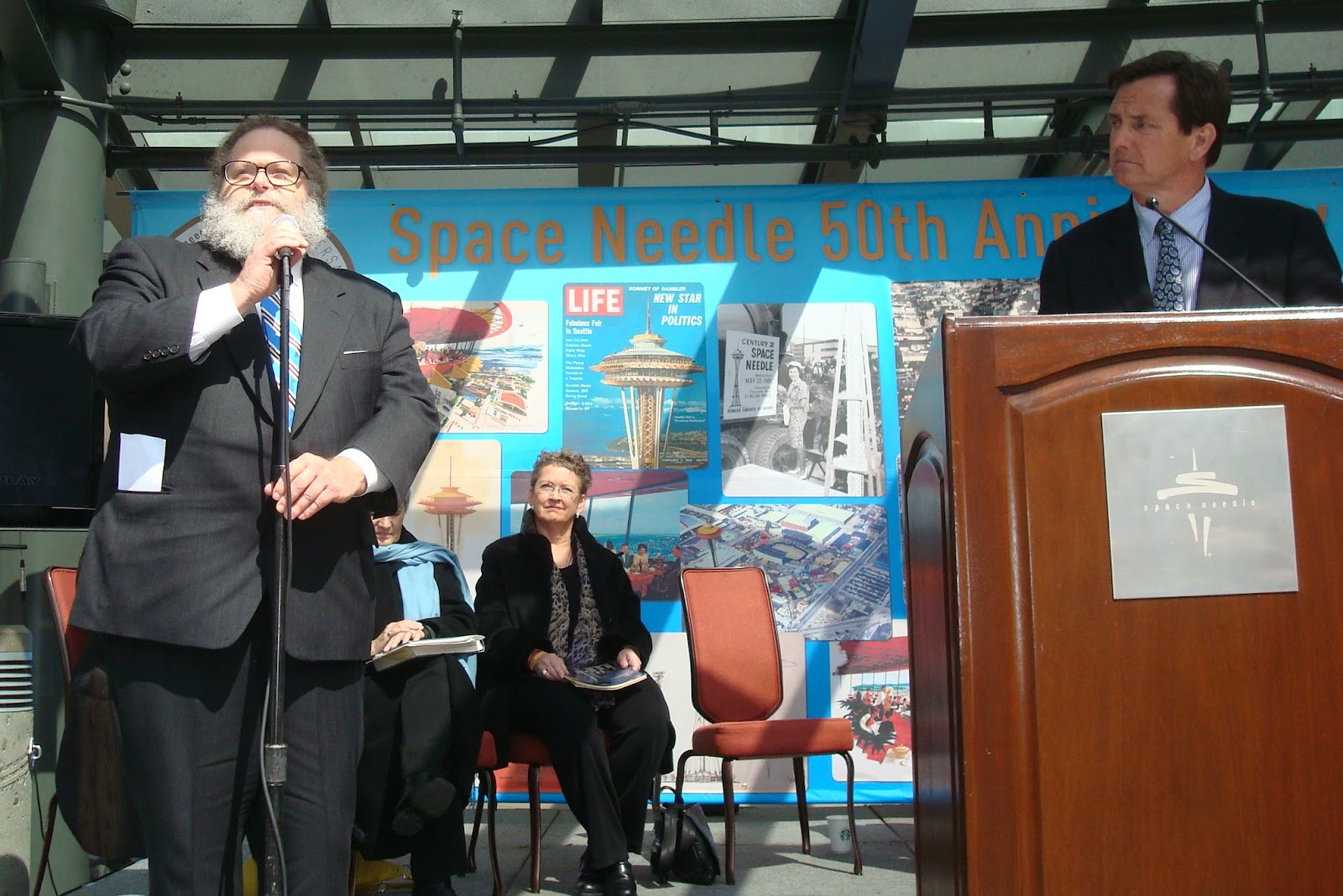
It was the 50th Anniversary of the groundbreaking for the Space Needle that got me started thinking about Seattle natives.  I was asked to find as many of the folks involved in envisioning, building and opening the Needle as I could.  It was quite an interesting task and the group of people assembled said a lot about  Seattle and its natives.  The most common denominators are a pioneering spirit and an entrepreneurial bent. Seattle’s settlers were lumberjacks, fishermen, forest rangers and businessmen…and women. And their children and their children’s children inherited that drive.

When we had three generations of Seattle Natives painting the roof of the Space Needle back to its original color of galaxy gold, my friend C. David Hughbanks was flooded with memories of working at the World’s Fair. It made him giddy. And local writer extraordinaire, Knute “Skip” Berger, who pens regularly under the name “Mossback” (he looks like one too) relishes every minute of growing up here. Right down to seeing the Space Needle under construction from the Smith Tower as an 8-year-old Cub Scout.
Though in many ways I now wish I was, I am not a native.  Seattle has become my life.  I got in just under the wire before former daily columnist Emmett Watson formed the KBO, “Keep the Bastards Out”.  I was here to see Bill Kirschner build his first pair of red, white and blue K2 Skis on Vashon Island. And I was here to watch Jan sewing up bags that would go on the new framepacks named after her “JanSport”.  I knew Gordon Bowker before he went to Italy and came back with an affinity for coffee that he named Starbucks. The only Bill Gates we first heard about was Senior, who was our corporate lawyer. I could go on but still, I’m not a native.

I actually envy people who have lived in one place all their lives…even those who went away and then came back. Until I came to Seattle, I was a military transient.  My father was overseas when I was born and didn’t see me until I was almost 2 years old…had to be shocking, I’m sure. Mom and I lived with the grandparents on their farm until dad got home. Then I have vague recollections of a couple different houses and communities where we lived but, by the time I started school, we were on a non-stop one-year-turn-around… 13 schools (all public) in 12 years (two 5th grades). Although college and grad school found me in one place for most of five years, my parents moved three times while I was getting my degrees before settling in the “Other” Washington.

 My “lifetime” friends are all from college and beyond.  Recollections of my public school days are frankly pretty dim.  I barely had time to get to know my classmates before moving on. The first 20 years of my life were mostly about the experiences, not the people…although Jayne Mansfield and Mickey Hargitay did bring their daughter Mariska to our house for dinner one time…but that’s another story.

First generation Seattlites are a breed among themselves. Some speak Norwegian or Swedish.  Others, Chinese or Canadian or Yiddish. I have to say that some of my best friends are natives.  The stories they tell about parents and grandparents growing this city fascinate me to no end. Building skyscrapers like the Smith Tower. Digging the ship canal. Putting in Highway 99, the only freeway we had for years. And, perhaps the ultimate, being involved in building the Space Needle. That is an unparalleled benchmark in this town.

When someone tells me that they know so-and-so because they went to BF Day Elementary or Franklin High School with them or that their best friends were Beavers too (Ballard, that is), I know I’m in the presence of a true homey.  In deference to my Cougar friends, UW is virtually a pre-requisite higher-ed experience for the natives. As is being an original member of the Brothers Four folk group. And if you worked at the World’s Fair, driving a pedi-cab, working at an international pavilion or selling balloons, you hold a treasured place in many hearts.

Seattle natives are a discerning group.  Some have even left the city because “it’s not really Seattle anymore”.  It’s even changed pretty dramatically since I’ve been here.  The percentage of out-of-towners to natives is much larger now. Sometime I’ll tell you the story of the president of a major local bank (no longer in existence) saying that he and his senior management group agreed that the presentation by my new company was by far the best they’d heard but they just couldn’t do business with someone who wasn’t originally from Seattle.

In spite of all the rambling I did in my younger years, I’ve spent most of my adult life in Seattle. I’m often asked if all the moving around I did was hard on a kid.  My answer is that some take to it and others don’t.  Either way, it does often make you a different kind of person.  You’re not easily rattled. You’re very independent. And you’re more tolerant of others, less religious and much more liberal in your thinking than your parents. All qualities that seem to mesh pretty well with Seattle natives.

Being a Seattle native is a position of note. It’s seldom flaunted. After four decades or so here, I am still not a native. However, I do know where a lot of the bodies are buried and I can go cross-town from east to west pretty quickly by totally using residential streets. Finally, after all this time, some of my native friends are willing to grant me special dispensation as a Semi-Local. Suffice it to say, I've gone native in Seattle and I love it.

Thursday, June 28, 2012

Ann


The Dalai Lama was tired and wanted to go to bed.  He’d been on a very long flight and he just wasn’t up to talking to another journalist…even if it was Ann Curry from the Today Show.  Lucky me, I was elected to tell Ann and her producer that the interview they had been waiting all day to get wasn’t going to happen until the next morning. At least she was first in line…that was the only good news I had…so I lead with it.

 Ann took the news pretty well, being the professional that she is.  For me, with the open time she now had on her hands, we could have a nice chat and get to know each other a bit. Like me, she was raised in a military family. Her career started after she graduated from the University of Oregon.  The tie to the Northwest, where she got her first job in television, seemed quite important to her and a solid connection for us.

 That conversation was the beginning of a relationship that has lasted for several years now.  It even saw us through two Olympics together…Beijing and Vancouver.  We were planning to connect in London and based on today’s news, it appears that might still happen.

 Ann is a warm and engaging person.  She is intelligent, well read and intensely focused.  Her deep-seated humanitarianism has taken her all over the world where there is conflict and strife. That is what brought her to the interview with the Dalai Lama on his trip to the US amid tensions in his home country of Tibet. It was the first of three interviews she has done with His Holiness and all of them have been very revealing about his views on politics and human behavior.

 A chance meeting on a connecting flight from Tokyo to Beijing gave Ann and me hours to catch up on our travels.  She loved hearing about the mountain and ocean projects that I have worked on because of her concern for the environment.  When we arrived in Beijing, we talked daily and then she invited Jane and me to the Today Show set.  We actually sat in two director’s chairs at the side of the stage.  We felt like royalty, thanks to Ann, and then talked with her well into the night in the shadow of the Bird’s Nest stadium.

 In Vancouver, she brought me right onto the Grouse Mountain set, standing next to her with the "gang" as they went to commercial.  We sat by the fire during the breaks and caught up on her preparations for the next Dalai Lama interview.  It was in that conversation that she first mentioned to me that there might be something new in the offing for her career. It may have been in anticipation of the impending decision for her to move into the co-host position, which happened a year later.  It was clear, however, that she had other plans in mind and they focused on her strong interest in righting the wrongs of the world and helping those truly in need.

 On my regular trips to New York, we’ve connected on the Today Show set and had long interesting talks over tea about the problems of the world that we knew we couldn’t solve.  But we cared.  She cared.  That may be one of the reasons she is leaving the co-host job at the Today Show. She has serious concerns in a business that is becoming more frivolous and celebrity-focused every day.  Ann may just be too good a journalist and human being to laugh and play games while sitting in the chair.

 In our last email exchange, she said “Just trying to do good for others, you know?” And I do know.  I think she liked being the co-host but, even when she was doing that, she was the first to volunteer to go anywhere in the world that people were suffering or in trouble.  I have great respect for her as a network news person and wish her all that is good in the world, however this turns out.  She deserves it.  I hope to see her again sometime soon and be one of the thousands who want the best for her and can say it in person. Damn the ratings!

Wednesday, June 6, 2012

26 Hours


He lies next to his brother. He would have wanted that, I think. Robert Francis Kennedy carried a huge burden for almost five years after his brother John was assassinated. Bobby was up to it though.

It was an electric time in DC. I was interning on Capitol Hill and quietly (because my father was a military man at the Pentagon and it might have rubbed off on him) but avidly supporting Bobby candidacy for President. Those times were the greatest influence on my political beliefs throughout my life.

I stayed up late to watch the primary returns in California. It was such a rush to see Bobby win and non-stop television coverage was in vogue so the cameras followed him off the podium and into the kitchen. Chaos ensued and you could hear the pops of the gun.

It was a surreal sight and the thought of another assassination was mind-boggling. Yet there it was, right before our eyes.

Not much is said today about the next 26 hours, but Bobby hung on. There were brief moments of real hope that he would survive.  However, the reports from the doctors were increasingly discouraging. It was excruciating as we tried to occupy ourselves between hourly reports. Capitol Hill and the congressional offices there are normally alive with the hustle and bustle and constant chatter of lawmaking.  That day it was quiet as a church.

He died on the morning of June 6 and a day later, Bobby’s body arrived in New York.  The Requiem at St. Patrick’s Cathedral made you feel as though you were one of the mourners.  The television networks didn’t take a breather throughout the entire ordeal.  Teddy Kennedy stepped out the shadows that day and his eulogy for his brother gave me chills.

His body was moved by private train to DC with thousands lining the trackside to pay their respects. I  remember people placing coins on the tracks to be flattened into remembrances by the train. It had to move so slowly that they didn’t arrive to Arlington Cemetery until well after dark.  The service was brief and very understated.  The next morning the small white cross was all that remained when I took the photo above (with my Kodak Instamatic) and, to this day, only a small plaque has been placed on the burial spot.


Robert F. Kennedy and his brothers John and Teddy had great influence on our country.  They are all gone now. So much of what and who we are as a nation was reflected in the lives of those men.  There were other assassinations that have marred our history. JFK and Martin Luther King, both were stopped short of their goals. Other Presidents, Lincoln, Garfield and McKinley were shot by political idealists.  The details of their deaths are dwindling to postscripts in the history books. But for those of us alive in the 60’s, that 26 hours before Bobby died will not soon be forgotten. Nor will how those times shaped our lives.